Overview
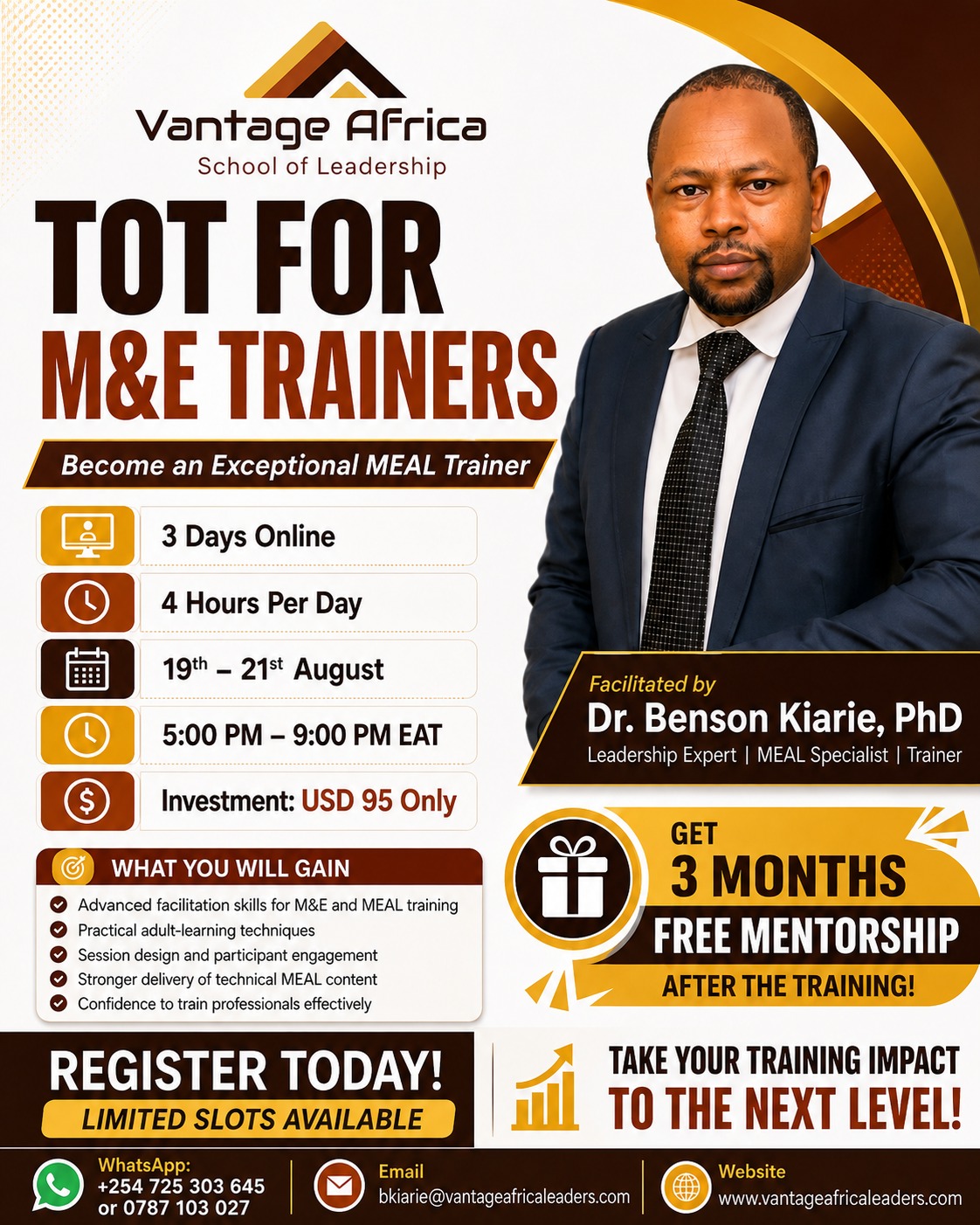
A specialist three-day live online programme for technically strong M&E professionals who want to become confident, structured and measurable trainers and facilitators.
Eval 360 - Advanced MEAL system with AI-Powered insights
As part of this training, every participant is onboarded onto Eval360, Vantage Africa's Digital AI-Enabled MEAL System built for organizations that need faster, more accurate, and more accountable M&E — without adding headcount. Participants will get guided, hands-on practice using Eval360 to:
- Advanced facilitation skills for M&E and MEAL training
- Practical adult-learning techniques
- Session design and participant engagement
- Confidence to train professionals effectively
- A certificate of completion
- Three months of mentorship
The Challenge
Knowledge-transfer gap — Professionals have strong M&E/MEAL expertise but can't effectively teach it to others. They know what but not how to train.
Poor facilitation confidence — Stage fright, nervousness, weak public speaking, and inability to command a room (virtual or in-person).
Unstructured training design — Trainers deliver content without proper needs assessments, learning objectives, lesson plans, or facilitator guides, leading to unfocused sessions.
Low learner engagement — Lectures that don't stick. The programme counters this with adult learning principles, experiential methods, and interactive techniques.
Difficulty managing group dynamics — Handling diverse personalities, disruptive participants, conflicts, and disengagement in professional settings.
Weak digital facilitation — Inability to leverage virtual tools (Zoom, breakout rooms, polls) effectively for online delivery.
No learning assessment — Trainers deliver content with no way to measure whether participants actually learned anything or whether it impacted the organization.
Lack of professional positioning — Technically skilled people who don't know how to market themselves as trainers or build consulting opportunities with NGOs, governments, and development partners.
The Solution
Technical knowledge and training ability. Most M&E professionals were never taught how to teach. They replicate the lecture-heavy formats they experienced, with predictably low retention and zero behavior change.
Demand outstrips supply. NGOs, governments, and development partners across Africa constantly need skilled MEAL trainers. There's a real market gap for facilitators who can deliver measurable learning outcomes, not just tick a "training conducted" box.
Virtual delivery is now non-negotiable. Post-COVID, organizations expect trainers to facilitate effectively online. Most haven't adapted.
Accountability is rising. Donors and organizations increasingly want proof that capacity-building investments actually work. Trainers need to design for measurable impact, not just attendance.
Professional opportunity. There's a direct consultancy pipeline for certified trainers who can work with NGOs, government agencies, and development partners across the continent.
Why This Programme
Knowing M&E is not the same as being able to teach it. This programme builds adult-learning, facilitation, training design, assessment and digital-delivery skills so participants can transfer technical knowledge with confidence.
What You'll Gain
- Professional lesson plan
- Facilitator guide
- Participant session plan
- Micro-teaching demonstration
- Personal trainer development plan
- Facilitation resource portfolio
Course Outline
- Role and ethics of a professional trainer
- Adult learning and learner-centred design
- Communication, public speaking and feedback
- Training Needs Assessment
- SMART learning objectives, lesson plans and guides
- Interactive facilitation methods
- Teaching technical M&E / MEAL concepts
- Online facilitation with Zoom and collaborative tools
- Knowledge checks and Kirkpatrick evaluation
- Trainer portfolio and consultancy readiness
- 15–20 minute micro-teaching assessment